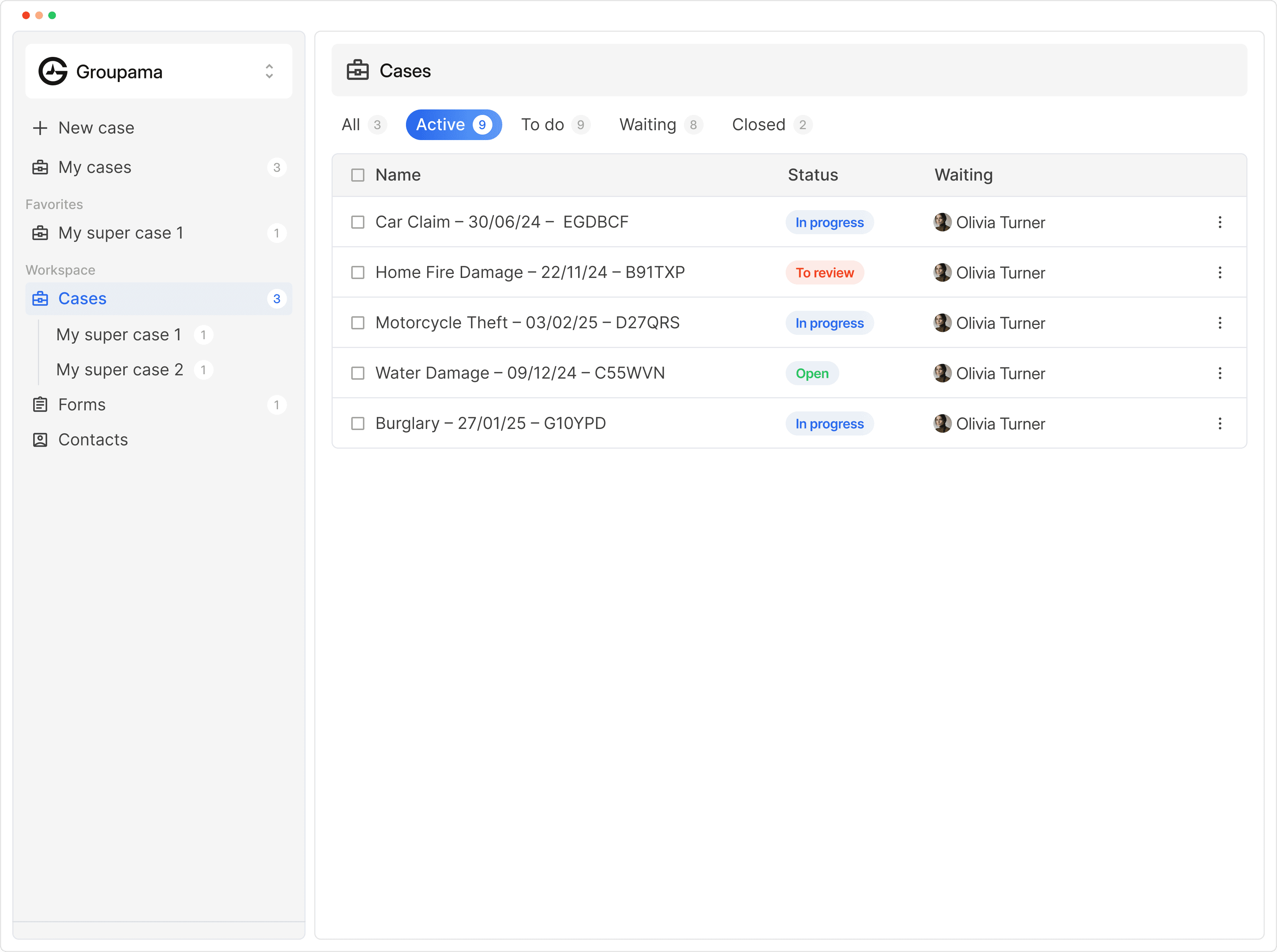
What is Case Management?
A complete guide for regulated operations
Your systems store cases. Now Penbox runs them.
Case management is the practice of coordinating everything required to take a request, claim, application, or issue from first contact through to a final, documented resolution. It brings together the people, documents, data, communications, and decisions tied to a single "case" so that nothing is lost, every step is traceable, and the outcome holds up to scrutiny. In document-heavy, regulated industries such as insurance and financial services, case management is the operational backbone that turns scattered emails and attachments into a controlled, auditable process.
This guide explains what case management is, how it works, the main types and models, how it differs from related disciplines like business process management (BPM) and CRM, what to look for in case management software, and how the discipline is changing as AI and "systems of action" reshape the way regulated teams work.
Case management is the practice of coordinating everything required to take a request, claim, application, or issue from first contact through to a final, documented resolution. It brings together the people, documents, data, communications, and decisions tied to a single "case" so that nothing is lost, every step is traceable, and the outcome holds up to scrutiny. In document-heavy, regulated industries such as insurance and financial services, case management is the operational backbone that turns scattered emails and attachments into a controlled, auditable process.
This guide explains what case management is, how it works, the main types and models, how it differs from related disciplines like business process management (BPM) and CRM, what to look for in case management software, and how the discipline is changing as AI and "systems of action" reshape the way regulated teams work.
What Is Case Management? A Clear Definition
Case management is the structured handling of a unit of work, a "case," from intake to resolution, including all the information, tasks, communications, documents, and decisions that belong to it. A case might be an insurance claim, a loan application, an onboarding file, a know-your-customer (KYC) review, a complaint, or a service request. Case management is the coordination layer that keeps that work moving, assigns ownership, tracks status, and produces a complete record of what happened and why.
What sets case management apart from simple task tracking is that cases are often unpredictable. Penbox describes case management as the discipline of coordinating everything tied to a single case, from the documents and data to the communications and decisions, and driving it from intake to a complete, traceable, and audit-ready resolution. The path to resolution is not always linear. New information arrives, priorities shift, exceptions appear, and human judgment is needed at key points.
In short:
A case is the container for everything related to one request or matter.
Case management is the discipline of moving that case from start to finish in a controlled, traceable way.
Case management software is the technology that automates and governs the process.
What Is Case Management? A Clear Definition
Case management is the structured handling of a unit of work, a "case," from intake to resolution, including all the information, tasks, communications, documents, and decisions that belong to it. A case might be an insurance claim, a loan application, an onboarding file, a know-your-customer (KYC) review, a complaint, or a service request. Case management is the coordination layer that keeps that work moving, assigns ownership, tracks status, and produces a complete record of what happened and why.
What sets case management apart from simple task tracking is that cases are often unpredictable. Penbox describes case management as the discipline of coordinating everything tied to a single case, from the documents and data to the communications and decisions, and driving it from intake to a complete, traceable, and audit-ready resolution. The path to resolution is not always linear. New information arrives, priorities shift, exceptions appear, and human judgment is needed at key points.
In short:
A case is the container for everything related to one request or matter.
Case management is the discipline of moving that case from start to finish in a controlled, traceable way.
Case management software is the technology that automates and governs the process.
What are the stages of the Case Management process?
Most cases follow a recognizable lifecycle, even when the exact path varies. The core stages are:
Intake. The case is created when a request arrives, by email, web form, phone, portal, or an upstream system. In insurance, this is often the First Notice of Loss (FNOL). Clean, complete intake is the highest-leverage stage in the entire process, because errors and gaps here compound at every later step.
Triage and assignment. The case is categorized, prioritized, and routed to the right person or team based on rules such as case type, complexity, or expertise.
Information and document collection. Missing details, forms, signatures, and supporting documents are gathered from the customer and other parties. This is where most delay and manual back-and-forth occurs.
Assessment and investigation. The owner reviews the file, checks it against policy terms or eligibility criteria, validates the facts, and gathers any further input needed to make a decision.
Decision and action. The case is approved, denied, settled, or otherwise resolved, often with documents generated and sent for review or signature.
Closure. The case is formally closed once all obligations are met, documentation is complete, and compliance checks are satisfied.
Audit and analysis. The complete record supports audits, regulatory review, and continuous improvement.
The reason these stages matter is that each handoff is a point where work can stall, data can be re-entered, and accountability can blur. A well-run case management process removes those friction points.
What are the stages of the Case Management process?
Most cases follow a recognizable lifecycle, even when the exact path varies. The core stages are:
Intake. The case is created when a request arrives, by email, web form, phone, portal, or an upstream system. In insurance, this is often the First Notice of Loss (FNOL). Clean, complete intake is the highest-leverage stage in the entire process, because errors and gaps here compound at every later step.
Triage and assignment. The case is categorized, prioritized, and routed to the right person or team based on rules such as case type, complexity, or expertise.
Information and document collection. Missing details, forms, signatures, and supporting documents are gathered from the customer and other parties. This is where most delay and manual back-and-forth occurs.
Assessment and investigation. The owner reviews the file, checks it against policy terms or eligibility criteria, validates the facts, and gathers any further input needed to make a decision.
Decision and action. The case is approved, denied, settled, or otherwise resolved, often with documents generated and sent for review or signature.
Closure. The case is formally closed once all obligations are met, documentation is complete, and compliance checks are satisfied.
Audit and analysis. The complete record supports audits, regulatory review, and continuous improvement.
The reason these stages matter is that each handoff is a point where work can stall, data can be re-entered, and accountability can blur. A well-run case management process removes those friction points.
1
Intake
A case is created from a request, claim, or document.
2
Triage
It is classified, prioritized, and routed to the right owner.
3
Processing
Tasks, checks, and information are gathered and actioned.
4
Review
Decisions are validated against rules and compliance.
5
Resolution
The case is closed with a documented, auditable outcome.
Why is Case Management important?
Case management matters because the cost of doing it poorly is high and largely hidden. When cases are run through inboxes and spreadsheets, work stalls, information gets lost, and no one has a clear view of status or ownership.
The financial impact is significant. According to the McKinsey Global Institute's report "The social economy: Unlocking value and productivity through social technologies," the average interaction worker spends nearly 20% of the workweek "looking for internal information or tracking down colleagues who can help with specific tasks," on top of the 28% spent managing email. The cost of poor data is just as stark: research from MIT Sloan Management Review (with Cork University Business School) estimates that poor data quality costs organizations between 15% and 25% of revenue, while Gartner has put the average cost at $12.9 million per organization per year. Those losses show up as rework, delays, and errors, much of it generated by manual handling of exactly the kind of work case management is meant to govern.
In claims specifically, the performance gap between leaders and laggards is wide. McKinsey found that "top-performing insurers have nearly 80 percent of customers rate them a nine or a ten out of ten based on their experience," versus only 25% for the bottom quartile, and much of that gap traces back to how efficiently and transparently cases are handled rather than to headcount.
For regulated operations, the stakes go beyond efficiency:
Compliance. Insurance and financial services are governed by strict timelines, documentation standards, and fair-handling obligations. Missing a state-mandated deadline or failing to document a decision can lead to fines, litigation, and reputational damage.
Auditability. Regulators expect a complete, time-stamped record of every action, document, and communication tied to a case.
Customer experience. A fast, transparent process is one of the biggest drivers of a customer's decision to renew or recommend an insurer. McKinsey reports that "satisfied customers are 80 percent more likely to renew their policies than unsatisfied customers," and that best-in-class US auto carriers generated two to four times more new-business growth than competitors with weaker customer experience.
Cost control. Poor handling leads to "claims leakage," the difference between what a claim should cost and what it actually costs. Industry research compiled by Regure puts typical leakage at 5–10% of total claims costs, and some consultancies estimate 20–30% for certain property and casualty firms.
In other words, case management is where operational efficiency, regulatory compliance, and customer trust all meet.
Why is Case Management important?
Case management matters because the cost of doing it poorly is high and largely hidden. When cases are run through inboxes and spreadsheets, work stalls, information gets lost, and no one has a clear view of status or ownership.
The financial impact is significant. According to the McKinsey Global Institute's report "The social economy: Unlocking value and productivity through social technologies," the average interaction worker spends nearly 20% of the workweek "looking for internal information or tracking down colleagues who can help with specific tasks," on top of the 28% spent managing email. The cost of poor data is just as stark: research from MIT Sloan Management Review (with Cork University Business School) estimates that poor data quality costs organizations between 15% and 25% of revenue, while Gartner has put the average cost at $12.9 million per organization per year. Those losses show up as rework, delays, and errors, much of it generated by manual handling of exactly the kind of work case management is meant to govern.
In claims specifically, the performance gap between leaders and laggards is wide. McKinsey found that "top-performing insurers have nearly 80 percent of customers rate them a nine or a ten out of ten based on their experience," versus only 25% for the bottom quartile, and much of that gap traces back to how efficiently and transparently cases are handled rather than to headcount.
For regulated operations, the stakes go beyond efficiency:
Compliance. Insurance and financial services are governed by strict timelines, documentation standards, and fair-handling obligations. Missing a state-mandated deadline or failing to document a decision can lead to fines, litigation, and reputational damage.
Auditability. Regulators expect a complete, time-stamped record of every action, document, and communication tied to a case.
Customer experience. A fast, transparent process is one of the biggest drivers of a customer's decision to renew or recommend an insurer. McKinsey reports that "satisfied customers are 80 percent more likely to renew their policies than unsatisfied customers," and that best-in-class US auto carriers generated two to four times more new-business growth than competitors with weaker customer experience.
Cost control. Poor handling leads to "claims leakage," the difference between what a claim should cost and what it actually costs. Industry research compiled by Regure puts typical leakage at 5–10% of total claims costs, and some consultancies estimate 20–30% for certain property and casualty firms.
In other words, case management is where operational efficiency, regulatory compliance, and customer trust all meet.
30%
of case-handling time is lost just searching for the right information.
5×
slower resolution when work runs through inboxes and spreadsheets.
100%
auditable trail when every action lives in one governed system.
What are the types and models of Case Management?
"Case management" spans many industries, and the term carries slightly different meanings depending on context. Broadly, there are two ways to categorize it: by industry application and by working model.
Case management by industry
Insurance. Claims handling, underwriting, policy changes, and KYC or compliance campaigns. These are document-heavy, deadline-driven, and highly regulated.
Financial services. Loan origination, account maintenance, dispute resolution, and anti-money-laundering investigations.
Customer service. Tracking and resolving customer issues across channels, often called ticketing or service case management.
Healthcare. Patient care coordination, claims, and care plans.
Legal. Matter management, discovery, deadlines, and document handling.
Social services and government. Benefits eligibility, citizen requests, and investigations.
Case management working models
In social work and healthcare, a well-established set of models is widely cited, and they are useful for understanding how "hands-on" a process is. As the NIH/PMC review "Effectiveness of Different Models of Case Management for Substance-Abusing Populations" summarizes, four models are distinguished in the literature: "the brokerage/generalist model, assertive community treatment/intensive case management, the clinical/rehabilitation model, and strengths-based case management" (Vanderplasschen et al. 2004; SAMHSA 1998).
Brokerage model. The most hands-off approach. The case manager assesses needs and connects the client to the right resources, then steps back.
Clinical model. The case manager is also a service provider, delivering and coordinating care directly.
Intensive model. Low caseloads, frequent contact, and close support for complex needs.
Strengths-based model. Focuses on the client's own strengths and resources to drive outcomes.
While these models come from social services, the underlying spectrum, from light coordination to deep, hands-on involvement, maps directly onto financial and insurance operations, where a simple policy change sits at one end and a complex, contested claim sits at the other.
Dynamic and adaptive case management
A particularly important category for regulated operations is dynamic case management (DCM), also called adaptive case management (ACM). This refers to handling cases whose path cannot be fully predicted in advance, where knowledge workers need to make judgment calls and the workflow has to adapt in real time. DCM is well suited to claims processing, underwriting, dispute resolution, and compliance investigations, precisely the work that does not fit a rigid, linear script.
What are the types and models of Case Management?
"Case management" spans many industries, and the term carries slightly different meanings depending on context. Broadly, there are two ways to categorize it: by industry application and by working model.
Case management by industry
Insurance. Claims handling, underwriting, policy changes, and KYC or compliance campaigns. These are document-heavy, deadline-driven, and highly regulated.
Financial services. Loan origination, account maintenance, dispute resolution, and anti-money-laundering investigations.
Customer service. Tracking and resolving customer issues across channels, often called ticketing or service case management.
Healthcare. Patient care coordination, claims, and care plans.
Legal. Matter management, discovery, deadlines, and document handling.
Social services and government. Benefits eligibility, citizen requests, and investigations.
Case management working models
In social work and healthcare, a well-established set of models is widely cited, and they are useful for understanding how "hands-on" a process is. As the NIH/PMC review "Effectiveness of Different Models of Case Management for Substance-Abusing Populations" summarizes, four models are distinguished in the literature: "the brokerage/generalist model, assertive community treatment/intensive case management, the clinical/rehabilitation model, and strengths-based case management" (Vanderplasschen et al. 2004; SAMHSA 1998).
Brokerage model. The most hands-off approach. The case manager assesses needs and connects the client to the right resources, then steps back.
Clinical model. The case manager is also a service provider, delivering and coordinating care directly.
Intensive model. Low caseloads, frequent contact, and close support for complex needs.
Strengths-based model. Focuses on the client's own strengths and resources to drive outcomes.
While these models come from social services, the underlying spectrum, from light coordination to deep, hands-on involvement, maps directly onto financial and insurance operations, where a simple policy change sits at one end and a complex, contested claim sits at the other.
Dynamic and adaptive case management
A particularly important category for regulated operations is dynamic case management (DCM), also called adaptive case management (ACM). This refers to handling cases whose path cannot be fully predicted in advance, where knowledge workers need to make judgment calls and the workflow has to adapt in real time. DCM is well suited to claims processing, underwriting, dispute resolution, and compliance investigations, precisely the work that does not fit a rigid, linear script.
Case Management vs. BPM vs. Workflow vs. CRM
One of the most common points of confusion is how case management relates to neighboring disciplines. The distinctions matter when you are choosing tools.
Case management vs. business process management (BPM)
BPM and case management share infrastructure, processes, rules, forms, and data, but they take different approaches:
BPM is process-centric. It works best for structured, predictable, repeatable workflows where the sequence of steps is known in advance, such as employee onboarding. As one industry analysis puts it, "BPM focuses on structured processes and case management focuses on less structured processes."
Case management is data- and knowledge-centric. It works best for complex, variable work where the path depends on the specifics of each case and human judgment drives the next step.
A helpful analogy: BPM is like planning a fixed driving route from A to B. Case management is for situations where the destination is set but the route keeps changing based on what you learn along the way. In practice, many regulated operations need both: a structured backbone for the predictable steps and case-management flexibility for the exceptions.
Case management vs. workflow management
Workflow management is narrower. It sequences and automates tasks within a process. Case management is broader: it coordinates people, documents, data, and decisions across an entire case, of which workflows may be one component.
Case management vs. CRM
A CRM (customer relationship management) system is built to store data about customers and relationships. Case management is built to move work to resolution. The two are complementary, not interchangeable. A CRM records what is true about a customer; case management decides and executes what should happen next on a given matter. This distinction, between storing data and acting on it, is central to where the discipline is heading.
Case Management vs. BPM vs. Workflow vs. CRM
One of the most common points of confusion is how case management relates to neighboring disciplines. The distinctions matter when you are choosing tools.
Case management vs. business process management (BPM)
BPM and case management share infrastructure, processes, rules, forms, and data, but they take different approaches:
BPM is process-centric. It works best for structured, predictable, repeatable workflows where the sequence of steps is known in advance, such as employee onboarding. As one industry analysis puts it, "BPM focuses on structured processes and case management focuses on less structured processes."
Case management is data- and knowledge-centric. It works best for complex, variable work where the path depends on the specifics of each case and human judgment drives the next step.
A helpful analogy: BPM is like planning a fixed driving route from A to B. Case management is for situations where the destination is set but the route keeps changing based on what you learn along the way. In practice, many regulated operations need both: a structured backbone for the predictable steps and case-management flexibility for the exceptions.
Case management vs. workflow management
Workflow management is narrower. It sequences and automates tasks within a process. Case management is broader: it coordinates people, documents, data, and decisions across an entire case, of which workflows may be one component.
Case management vs. CRM
A CRM (customer relationship management) system is built to store data about customers and relationships. Case management is built to move work to resolution. The two are complementary, not interchangeable. A CRM records what is true about a customer; case management decides and executes what should happen next on a given matter. This distinction, between storing data and acting on it, is central to where the discipline is heading.
Approach
Case Management
BPM
Workflow
CRM
Best for
Complex, document-heavy cases
Standardized high-volume processes
Simple task routing
Customer relationships
Structure
Flexible, knowledge-driven
Rigid & predefined
Linear, fixed steps
Record-centric
The record is
The case itself
A process instance
A task list
A contact or account
What features should Case Management software have?
Modern case management software brings the whole process into one governed system. The features that matter most for document-heavy, regulated operations are:
Multi-channel intake. Capture cases from email, web forms, portals, and upstream systems, and turn unstructured inputs into structured cases automatically.
Document collection and intelligence. Request documents, forms, and e-signatures, send automatic reminders, and use AI to read uploaded files, including handwritten forms, scanned PDFs, and photos, and extract the data the team needs.
Structured data capture. Replace free-text email threads with structured fields that feed cleanly into downstream systems.
Routing and assignment. Rules-based triage, prioritization, and clear case ownership.
Workflow automation with exception handling. Automate the predictable path while still managing the exceptions that define real casework.
Deadline reminders and automated escalations. Monitor deadlines and escalate at-risk cases automatically, critical where regulatory timelines apply.
Audit trail. A complete, time-stamped, traceable log of every action, document, and communication.
Security and compliance. Encryption, role-based access, data residency, and certifications such as ISO 27001, plus GDPR alignment for European operations.
Analytics and reporting. Visibility into volumes, cycle times, bottlenecks, and compliance status.
Integration. The ability to connect to the systems you already use, CRMs, policy administration systems, ERPs, file storage, and email.
That last point, integration, is where modern case management is undergoing its most important shift.
What features should Case Management software have?
Modern case management software brings the whole process into one governed system. The features that matter most for document-heavy, regulated operations are:
Multi-channel intake. Capture cases from email, web forms, portals, and upstream systems, and turn unstructured inputs into structured cases automatically.
Document collection and intelligence. Request documents, forms, and e-signatures, send automatic reminders, and use AI to read uploaded files, including handwritten forms, scanned PDFs, and photos, and extract the data the team needs.
Structured data capture. Replace free-text email threads with structured fields that feed cleanly into downstream systems.
Routing and assignment. Rules-based triage, prioritization, and clear case ownership.
Workflow automation with exception handling. Automate the predictable path while still managing the exceptions that define real casework.
Deadline reminders and automated escalations. Monitor deadlines and escalate at-risk cases automatically, critical where regulatory timelines apply.
Audit trail. A complete, time-stamped, traceable log of every action, document, and communication.
Security and compliance. Encryption, role-based access, data residency, and certifications such as ISO 27001, plus GDPR alignment for European operations.
Analytics and reporting. Visibility into volumes, cycle times, bottlenecks, and compliance status.
Integration. The ability to connect to the systems you already use, CRMs, policy administration systems, ERPs, file storage, and email.
That last point, integration, is where modern case management is undergoing its most important shift.
Modern Case Management: A "System of Action" on top of your existing systems
For years, the dominant model was to push case management inside a large suite, typically a CRM or ERP. In that model, case management is treated as a function of the broader platform, pulling requests into a centralized system that also serves as the company's database of record. These are "systems of record": they are excellent at storing data inside their own boundaries.
But storing data and acting on it are different jobs. A growing body of industry analysis distinguishes between a system of record, which stores what is true, and a system of action, which decides and executes what should happen next. As one analysis puts it, "Systems of record store what is. Systems of action decide and execute what should happen next."
This distinction has a practical, and competitive, consequence. A system of action has to coordinate across many systems, including ones from different vendors. A system of record is, by design, incentivized to keep work inside its own ecosystem. As one analysis of the category notes, "Systems of record are incentivized to deepen lock-in to their own models and workflows. A system of action must orchestrate across multiple systems, including competitors, which creates an inherent conflict."
This is why the most modern approach to case management does not try to replace the systems you already run. Instead, it sits on top of them as a coordination layer. Your CRM, policy administration system, or ERP stays the system of record. The case management layer runs the actual work, collecting documents, chasing missing information, guiding next steps, and syncing clean data back to your core systems.
The advantage of this model is interoperability. A case management platform built to live on top of existing systems can, in principle, connect to almost any tool an organization already uses, rather than forcing teams into a single vendor's ecosystem. For regulated operations that have invested heavily in core systems and cannot rip them out, this "layer on top" approach is far less disruptive than a wholesale platform replacement. It is also a clear point of difference from case management that is locked inside a CRM or ERP suite.
Penbox, a European case intelligence platform used by insurers and brokers including Allianz, Groupama, and Qover, is one example of this model. Its positioning captures the idea directly: "Your systems stay the system of record. Penbox runs the case work on top." This reflects a broader movement in regulated operations away from monolithic suites and toward interoperable layers that coordinate work across whatever systems are already in place.
Modern Case Management: A "System of Action" on top of your existing systems
For years, the dominant model was to push case management inside a large suite, typically a CRM or ERP. In that model, case management is treated as a function of the broader platform, pulling requests into a centralized system that also serves as the company's database of record. These are "systems of record": they are excellent at storing data inside their own boundaries.
But storing data and acting on it are different jobs. A growing body of industry analysis distinguishes between a system of record, which stores what is true, and a system of action, which decides and executes what should happen next. As one analysis puts it, "Systems of record store what is. Systems of action decide and execute what should happen next."
This distinction has a practical, and competitive, consequence. A system of action has to coordinate across many systems, including ones from different vendors. A system of record is, by design, incentivized to keep work inside its own ecosystem. As one analysis of the category notes, "Systems of record are incentivized to deepen lock-in to their own models and workflows. A system of action must orchestrate across multiple systems, including competitors, which creates an inherent conflict."
This is why the most modern approach to case management does not try to replace the systems you already run. Instead, it sits on top of them as a coordination layer. Your CRM, policy administration system, or ERP stays the system of record. The case management layer runs the actual work, collecting documents, chasing missing information, guiding next steps, and syncing clean data back to your core systems.
The advantage of this model is interoperability. A case management platform built to live on top of existing systems can, in principle, connect to almost any tool an organization already uses, rather than forcing teams into a single vendor's ecosystem. For regulated operations that have invested heavily in core systems and cannot rip them out, this "layer on top" approach is far less disruptive than a wholesale platform replacement. It is also a clear point of difference from case management that is locked inside a CRM or ERP suite.
Penbox, a European case intelligence platform used by insurers and brokers including Allianz, Groupama, and Qover, is one example of this model. Its positioning captures the idea directly: "Your systems stay the system of record. Penbox runs the case work on top." This reflects a broader movement in regulated operations away from monolithic suites and toward interoperable layers that coordinate work across whatever systems are already in place.
Case Management in Insurance and Financial Services
Because insurance and financial services are so document- and compliance-intensive, they are among the clearest examples of where strong case management pays off.
Claims management
A claim is a textbook case: it starts with FNOL, requires documents and evidence from multiple parties, passes through assessment and possibly investigation, and ends in a decision that must be documented and defensible. Manual, email-driven claims handling is slow, error-prone, and hard to audit. Structured case management shortens cycle times, protects SLAs, and maintains a full audit trail from first notice to final decision.
Underwriting and onboarding
Underwriting and new-business onboarding depend on collecting, validating, approving, and signing a defined set of information. Case management turns this into a controlled workflow with shorter cycle times, fewer errors, and clear accountability.
Customer servicing and policy changes
Routine updates and renewals generate enormous volumes of low-complexity work that still has to be handled accurately and traceably. Case management removes the email back-and-forth while keeping every interaction logged.
Compliance and KYC campaigns
Portfolio-wide compliance and KYC updates require collecting information from large numbers of customers, tracking submissions, automating reminders, and maintaining defensible records. This is case management at scale, and it is nearly impossible to do well with manual tools.
The common thread across all four is the same: regulated work is full of documents, deadlines, and exceptions, and the organizations that handle it best are the ones that structure it into governed, auditable workflows rather than running it through inboxes.
Case Management in Insurance and Financial Services
Because insurance and financial services are so document- and compliance-intensive, they are among the clearest examples of where strong case management pays off.
Claims management
A claim is a textbook case: it starts with FNOL, requires documents and evidence from multiple parties, passes through assessment and possibly investigation, and ends in a decision that must be documented and defensible. Manual, email-driven claims handling is slow, error-prone, and hard to audit. Structured case management shortens cycle times, protects SLAs, and maintains a full audit trail from first notice to final decision.
Underwriting and onboarding
Underwriting and new-business onboarding depend on collecting, validating, approving, and signing a defined set of information. Case management turns this into a controlled workflow with shorter cycle times, fewer errors, and clear accountability.
Customer servicing and policy changes
Routine updates and renewals generate enormous volumes of low-complexity work that still has to be handled accurately and traceably. Case management removes the email back-and-forth while keeping every interaction logged.
Compliance and KYC campaigns
Portfolio-wide compliance and KYC updates require collecting information from large numbers of customers, tracking submissions, automating reminders, and maintaining defensible records. This is case management at scale, and it is nearly impossible to do well with manual tools.
The common thread across all four is the same: regulated work is full of documents, deadlines, and exceptions, and the organizations that handle it best are the ones that structure it into governed, auditable workflows rather than running it through inboxes.
How is AI changing Case Management?
AI is reshaping case management, particularly in document-heavy, regulated work. The most meaningful applications today are:
Document intelligence. AI reads and extracts structured data from unstructured inputs, scanned PDFs, handwritten forms, and photos, removing a major source of manual data entry.
Intelligent triage and routing. Machine learning prioritizes cases by risk and complexity and routes them to the right owner.
Drafting and summarization. AI summarizes long case files and drafts communications, freeing knowledge workers for judgment-based work.
Agentic workflows with guardrails. Newer approaches let AI agents handle parts of a case within defined boundaries, escalating to a human for exceptions, approvals, or high-risk decisions, while keeping a complete audit trail.
The key constraint in regulated industries is that AI must operate inside clear controls. Speed cannot come at the expense of compliance, transparency, or auditability. The strongest implementations blend automation with human oversight rather than replacing judgment entirely.
How is AI changing Case Management?
AI is reshaping case management, particularly in document-heavy, regulated work. The most meaningful applications today are:
Document intelligence. AI reads and extracts structured data from unstructured inputs, scanned PDFs, handwritten forms, and photos, removing a major source of manual data entry.
Intelligent triage and routing. Machine learning prioritizes cases by risk and complexity and routes them to the right owner.
Drafting and summarization. AI summarizes long case files and drafts communications, freeing knowledge workers for judgment-based work.
Agentic workflows with guardrails. Newer approaches let AI agents handle parts of a case within defined boundaries, escalating to a human for exceptions, approvals, or high-risk decisions, while keeping a complete audit trail.
The key constraint in regulated industries is that AI must operate inside clear controls. Speed cannot come at the expense of compliance, transparency, or auditability. The strongest implementations blend automation with human oversight rather than replacing judgment entirely.
How to choose a Case Management solution
When evaluating case management software for a regulated operation, focus on these questions:
Does it fit how your team actually works? Look for adaptability to your case types and the ability to handle exceptions, not just the happy path.
Does it connect to your existing systems? Favor solutions that layer on top of your current CRM, policy system, and tools rather than forcing a replacement or locking you into one vendor's ecosystem.
Is it built for compliance? Check for audit trails, role-based access, data residency, encryption, and relevant certifications.
How fast can you go live? Modern platforms can launch in weeks, not quarters. Long, IT-heavy implementations are a warning sign.
Does it handle documents well? For document-heavy operations, document collection, e-signatures, and AI-based extraction are essential, not optional.
Will it scale? Make sure it can handle portfolio-wide campaigns and growing case volumes without added headcount.
A useful rule of thumb: if a solution requires you to move all your data into its ecosystem before it adds value, it is a system of record. If it can start adding value on top of what you already run, with minimal integration, and expand as your needs grow, it is a system of action.
How to choose a Case Management solution
When evaluating case management software for a regulated operation, focus on these questions:
Does it fit how your team actually works? Look for adaptability to your case types and the ability to handle exceptions, not just the happy path.
Does it connect to your existing systems? Favor solutions that layer on top of your current CRM, policy system, and tools rather than forcing a replacement or locking you into one vendor's ecosystem.
Is it built for compliance? Check for audit trails, role-based access, data residency, encryption, and relevant certifications.
How fast can you go live? Modern platforms can launch in weeks, not quarters. Long, IT-heavy implementations are a warning sign.
Does it handle documents well? For document-heavy operations, document collection, e-signatures, and AI-based extraction are essential, not optional.
Will it scale? Make sure it can handle portfolio-wide campaigns and growing case volumes without added headcount.
A useful rule of thumb: if a solution requires you to move all your data into its ecosystem before it adds value, it is a system of record. If it can start adding value on top of what you already run, with minimal integration, and expand as your needs grow, it is a system of action.
Frequently Asked Questions
What is case management in simple terms?
Case management is the process of handling a request, claim, application, or issue from start to finish, keeping all the related information, documents, tasks, and decisions together so the work moves forward in a controlled, traceable way.
What is the difference between case management and a CRM?
A CRM stores information about customers and relationships. Case management moves work to resolution. A CRM records what is true; case management decides and executes what happens next on a specific matter. They work best together, with case management running on top of the CRM.
What is the difference between case management and BPM?
BPM (business process management) is best for structured, predictable, repeatable processes. Case management is best for complex, variable work where the path depends on the specifics of each case and requires human judgment. Many organizations use both.
What is dynamic or adaptive case management?
Dynamic case management (DCM), also called adaptive case management (ACM), handles cases whose path cannot be fully predicted in advance. Workflows adapt in real time as new information arrives, which makes DCM well suited to claims, underwriting, and compliance investigations.
What industries use case management?
Case management is used across insurance, financial services, customer service, healthcare, legal, social services, and government. It is most valuable in document-heavy, regulated industries where compliance, auditability, and complex workflows are critical.
What is a "system of action" in case management?
A system of action is software that executes work and drives outcomes, rather than simply storing data. In case management, it is a layer that sits on top of your systems of record (such as your CRM or policy system), runs the actual case work, and syncs clean data back, coordinating across whatever tools you already use.
What should I look for in case management software?
Prioritize multi-channel intake, document collection and AI-based extraction, structured data capture, rules-based routing, workflow automation with exception handling, SLA tracking, a complete audit trail, strong security and compliance, analytics, and broad integration with your existing systems.
Frequently Asked Questions
What is case management in simple terms?
Case management is the process of handling a request, claim, application, or issue from start to finish, keeping all the related information, documents, tasks, and decisions together so the work moves forward in a controlled, traceable way.
What is the difference between case management and a CRM?
A CRM stores information about customers and relationships. Case management moves work to resolution. A CRM records what is true; case management decides and executes what happens next on a specific matter. They work best together, with case management running on top of the CRM.
What is the difference between case management and BPM?
BPM (business process management) is best for structured, predictable, repeatable processes. Case management is best for complex, variable work where the path depends on the specifics of each case and requires human judgment. Many organizations use both.
What is dynamic or adaptive case management?
Dynamic case management (DCM), also called adaptive case management (ACM), handles cases whose path cannot be fully predicted in advance. Workflows adapt in real time as new information arrives, which makes DCM well suited to claims, underwriting, and compliance investigations.
What industries use case management?
Case management is used across insurance, financial services, customer service, healthcare, legal, social services, and government. It is most valuable in document-heavy, regulated industries where compliance, auditability, and complex workflows are critical.
What is a "system of action" in case management?
A system of action is software that executes work and drives outcomes, rather than simply storing data. In case management, it is a layer that sits on top of your systems of record (such as your CRM or policy system), runs the actual case work, and syncs clean data back, coordinating across whatever tools you already use.
What should I look for in case management software?
Prioritize multi-channel intake, document collection and AI-based extraction, structured data capture, rules-based routing, workflow automation with exception handling, SLA tracking, a complete audit trail, strong security and compliance, analytics, and broad integration with your existing systems.
Conclusion
Case management is the discipline of moving complex, document-heavy work from intake to resolution in a controlled, auditable way. For insurers, brokers, and financial operations, it is the difference between work that stalls in inboxes and work that moves predictably while staying compliant. The most important shift underway is architectural: rather than locking case management inside a single CRM or ERP suite, modern operations increasingly run it as a "system of action" that lives on top of their existing systems and connects to whatever tools they already use. That approach delivers the speed and structure of strong case management without the disruption, and the lock-in, of replacing the systems a regulated business already depends on.
Conclusion
Case management is the discipline of moving complex, document-heavy work from intake to resolution in a controlled, auditable way. For insurers, brokers, and financial operations, it is the difference between work that stalls in inboxes and work that moves predictably while staying compliant. The most important shift underway is architectural: rather than locking case management inside a single CRM or ERP suite, modern operations increasingly run it as a "system of action" that lives on top of their existing systems and connects to whatever tools they already use. That approach delivers the speed and structure of strong case management without the disruption, and the lock-in, of replacing the systems a regulated business already depends on.
From first customer interaction to cases that run themselves.
From first customer interaction to cases that run themselves.
Start with one case. Launch in weeks, not quarters.
See the difference. Expand as you grow.
Start with one case. Launch in weeks, not quarters. See the difference. Expand as you grow.